#include <SimSeqs.h>
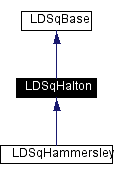
Inheritance diagram for LDSqHalton:
Public Methods | |
| LDSqHalton (long *b=NULL, long dm=0, long iterations=0, long genau=BGENAU, double genau1=GENAU, char *ex="hal",char *nm="Halton") | |
Protected Methods | |
| virtual long | CalculateNextElement (long nr, double *buffer, long bufflen) |
| virtual long | InitData (long genau, double genau1) |
| virtual long | ExitData () |
| virtual long* | InitGenericBases (long dm) |
Protected Attributes | |
| long | prec |
| double* | q |
| double * | p |
The VanDerCorput Sequence is just a special case with dim=1.
|
|
|
|
|
Calculates the next element from the current element (or if we need a different element it calculates it using the function Phi. If bufflen>dim=length(bases), the remaining dimensions are filled with pseudo-random numbers.
Reimplemented from LDSqBase. Reimplemented in LDSqHammersley. |
|
|
Do class-specific freeing of memory etc. Called by the destructor Reimplemented from LDSqBase. |
|
|
Precalculate some values needed to create the numbers much faster (recursively).
Reimplemented from LDSqBase. |
|
|
If no array of bases was given in the constructor, but the sequence needs them, this creates generic bases, e.g. most of the time these are the dm lowest prime numbers, but you can override this by reimplementing InitGenericBases in your subclass Reimplemented from LDSqBase. |
|
|
Stores 1/2^i and 1-1/2^i to speed up the calculation (recursive!!!).
|
|
|
Precision (in powers of 1/2). We need this many precreated numbers 1/2^i and the other corresponding value 1-1/2^1 in p and q |
|
|
Stores 1/2^i and 1-1/2^i to speed up the calculation (recursive!!!).
|
 1.2.7 written by Dimitri van Heesch,
© 1997-2001
1.2.7 written by Dimitri van Heesch,
© 1997-2001