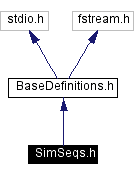
#include "BaseDefinitions.h"Include dependency graph for SimSeqs.h:
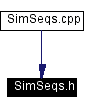
This graph shows which files directly or indirectly include this file:
Go to the source code of this file.
Compounds | |
| class | LDSqAfflerbach |
| Afflerbach is a special Pseudorandomnumber generator that uses a linear congruence operator (quite fast). More... | |
| class | LDSqAtanassov |
| This class implements Atanassov's modified Halton sequence. More... | |
| class | LDSqBase |
| This is the base class for all the simulation sequences including Monte Carlo (just random numbers). More... | |
| class | LDSqFaure |
| Implementation of the Faure low discrepancy sequence, use a linear field c to store the pascal matrix and multiply it on the previous coefficients by matrix-multiplication to get the new coefficients. More... | |
| class | LDSqHalton |
| This class implements the Halton Sequence in the bases stored in b passed to the constructor. More... | |
| class | LDSqHammersley |
| This class implements the Hammersley Set by creathing the Halton-sequence in dim-1 dimensions and adding the additional dimension of the form k/N. More... | |
| class | LDSqMonteCarlo |
| This class implements pseudo-random numbers. More... | |
| class | LDSqNAlpha |
| This class implements the N *Alpha Sequence. More... | |
| class | LDSqNetz |
| Implementation of the (0,s) nets, according to an algorithm given by Lecot for Niederreiter's construction using hyperderivatives of polynomials. More... | |
| class | LDSqNiederreiter |
| Implementation of (0,s) nets, according to an algorithm given by Niederreiter using monic polynomials. More... | |
| class | LDSqSobol |
| This class implements the Sobol Sequence, direction numbers are only available for 51 dimensions, so we can only provide that many dimensions. More... | |
| class | longpoly |
| This helper class describes polynomials with long coefficients. More... | |
| struct | polynom |
Defines | |
| #define | USEMC 1 |
| #define | USEHALTON 2 |
| #define | USENET 4 |
| #define | USENIEDER 8 |
| #define | USESOBOL 16 |
| #define | USEFAURE 32 |
| #define | USEATANASSOV 64 |
| #define | USEHAMMERSLEY 128 |
| #define | USENALPHA 256 |
| #define | USEMAX USENALPHA |
| #define | GENAU 1E-9 |
| #define | BGENAU 29 |
| #define | MAXLONG 2147483647 |
| #define | MAXPREC 30 |
| #define | primefile "primes.dat" |
| #define | NAlphaOnes .6180339887498948482045969343656391177203091798058 |
| #define | NAlphaTwos .4142135623730950488016887242096980785696718753769 |
| #define | NAlphaThrees .3027756377319946465596106337352479731256482869226 |
| #define | NAlphaFours .2360679774997896964091736687312762354406183596115 |
| #define | maxanz 310 |
| #define | max_nieder 900000000 |
| #define | maxdim 310 |
| #define | MAX_I_NORMAL 1025 |
| #define | NTAB 32 |
| #define | MC1 1 |
| #define | MC2 2 |
| #define | MC3 3 |
| #define | konst 1073741824 |
Typedefs | |
| typedef double | double_vektor [maxanz] |
| typedef int | int_vektor [maxanz] |
| typedef polynom | polarr [maxdim+4] |
Functions | |
| long | ReadPrimes (long *primes, long m) |
| long | NextPrime (long current) |
| long* | InitGenericPrimes (long dm) |
| long* | InitGenericInts (long dm) |
|
|
|
|
|
|
|
|
|
|
|
|
|
|
|
|
|
These gives the Monte Carlo Method (just pseudo-random numbers), defines constant for the LDSqMonteCarlo class.
|
|
|
|
|
|
|
|
|
|
|
|
some numbes for the nAlpha sequence: NAlphaOnes is [0;1,1,1,1,1,1,1,1....] NAlphaTwos is [0;2,2,2,2,2,2,2,2....] NAlphaThrees is [0;3,3,3,3,3,3,3,3....] NAlphaFours is [0;4,4,4,4,4,4,4,4....].
|
|
|
|
|
|
|
|
|
|
|
|
|
|
|
|
|
|
|
|
|
|
|
|
|
|
|
These constants define bitwise masks for variables that describe which sequence to use for your calculation. e.g. 107 means MC, Halton, Niederreiter, Faure and Atanassov |
|
|
|
|
|
|
|
|
|
|
|
|
|
|
|
|
|
|
|
|
|
|
|
|
|
|
|
|
|
|
|
|
|
|
|
|
|
|
returns a field of length dm filled with the smalles Integer numbers. Use this e.g. as bases for the Niederreiter sequence in a base p. The long* field has to be delete[]'ed manually. |
|
|
returns a field of length dm filled with the smalles prime numbers. Use this e.g. as bases for the Halton sequence. The long* field has to be delete[]'ed manually. |
|
|
Returns the smalles prime larger than or equal to "current".
|
|
|
This function reads in the first m primes from the file "primes.dat" in the working directory and stores them to primes, which must be large enough to hold all m primes.
|
 1.2.7 written by Dimitri van Heesch,
© 1997-2001
1.2.7 written by Dimitri van Heesch,
© 1997-2001